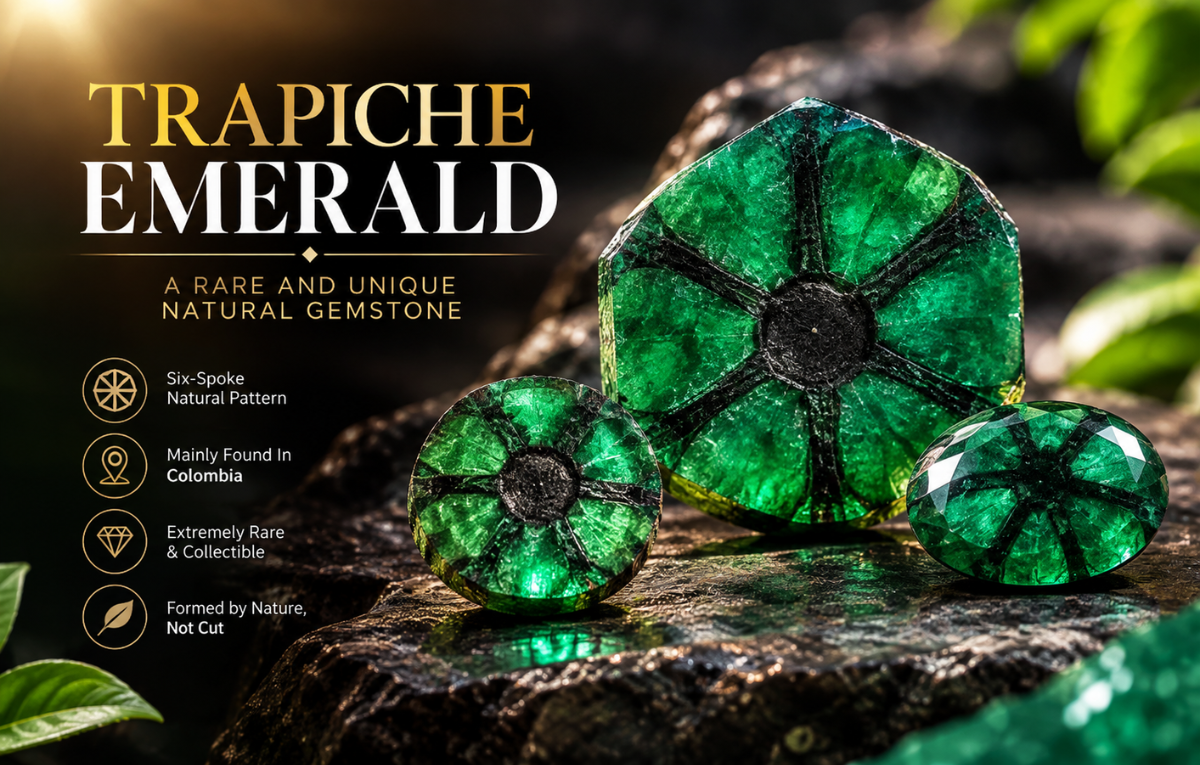
A Trapiche Emerald is one of the most rare, unique and collectible of emerald forms in the gemstone world. A trapiche emerald is identified by its fixed pattern which looks like a wheel with six spokes as opposed to the traditional emerald that’s valued for its green colour, clarity and brilliance. This natural formation makes it immediately stand out from regular emeralds, adding a distinctiveness to the gemstone.
Trapiche emeralds are particularly linked to Colombia and are regarded as a rare and unusual natural kind that is much sought-after by gemstone collectors.
What Is a Trapiche Emerald?
A natural emerald that forms in an emerald trapiche pattern known as a central area and 6 radiating arms is a emerald. If you look at the pattern from the correct angle, you may notice that it looks like the spokes of a wheel.
The term “trapiche” originates from a Spanish term related to a sugar mill grinding wheel. It was named for the fact that the pattern of the gemstone reminded the people of its shape and design as a wheel. Colombian trapiche emeralds are those that are described by GIA as having a distinct central core, six sectors of growth, and six clearly defined boundaries that define the characteristic six-rayed pattern.
Where Are Trapiche Emeralds Found?
Colombian emeralds are heavily linked with classic trapiche emeralds. They have been discovered in the western part of the Eastern Cordillera Basin of Colombia, in certain regions related to mining sites like Peñas Blancas, Muzo and Coscuez.
Their creation is linked to an unusual set of geological conditions, and includes black shale, hydrothermal fluids, changes in pressure and the growth of emerald crystals. It is because of these particular conditions, that trapiche emeralds are so rare in comparison to ordinary emeralds.
Emeralds of the trapiche type have been found in other places, such as the Swat Valley in Pakistan, but their patterns may be different than that of the classic Colombian material.
One Of The Rare Emerald Stones Sold In Its Natural State
It is one of the few emeralds offered in their natural form.
The prime feature of an Emerald Trapiche is its fixed 6 spoke pattern.
It is formed during crystal formation and not by cutting or polishing. Traditional Colombian gems may feature a central core with six growth sectors in the form of emeralds. Sometimes there are dark layers or mineral-rich edges between these sectors and the six arms are very evident.
The trapiche pattern is not to be confused with asterism. With a star sapphire, for instance, the star can shift across the surface as the stone or the light source is moved. The arms of a trapiche emerald stay fixed as the arms form part of the growth of the gemstone.
Color And Appearance
The green colour is the reason for the famous status of the emeralds, and the trapiche emeralds may show a variety of green colours. Its appearance is influenced by inclusions, zones of emerald growth and the material between these growth zones.
Some of the emeralds from trapiche have a a bright green core with lighter or darker color on the outside. There can be a more distinct contrast between the green emerald sectors and dark six-spoke pattern in others.
Not all trapiche emeralds will have the same pattern formed, since each natural crystal is formed in a unique way. It’s one such reason collectors like them so much.
Emeralds From Trapiche Come In A Variety Of Styles That Are Cut As You Will See
With a Trapiche Emerald the cutting style is particularly significant. The pattern that is so unique to it cannot be best displayed through the traditional faceting.
Emeralds are frequently cut in slices or cabochons with a cut that accentuates the sixfold growth pattern of the stone. Crystals may show the characteristic wheel-like pattern when cut across the crystal’s sixfold axis.
It can be more useful to a collector, then, to have a specimen well oriented than a stone that has been cut without retaining its natural pattern.
A Trapiche Emerald’s Value Depends On The Size Of Its Crystals
- The crystals of a trapiche emerald determine the value.
- There are some factors that can affect the value of a Trapiche Emerald.
Pattern Quality
A well defined and distinct 6-spotted pattern can make a specimen particularly attractive. Visual features include symmetry and visibility of arms.
Green Color
Like other emeralds attractive green color can add much to its desirability. A specimen can be more attractive if the color is strong and appealing.
Transparency
There are relatively transparent trapiche emeralds and those with a considerable amount of opaque material. The transparency should be taken into account with the visibility and quality of the trapiche pattern.
Size And Shape
Collectors may be interested in larger, better developed specimens. But size doesn’t necessarily mean quality.
Natural Formation
One of the most interesting aspects of the trapiche is that the pattern was ‘discovered’ in the natural world. When purchasing an important gemstone, buyers will want to rely on trusted information regarding the gemstone’s identity, its source, and if it is treated or not.
Trapiche Emerald Vs: Regular Emerald
The most common characteristics that are considered when determining the value of a traditional emerald are its green color, clarity, cut, carat weight, and overall appearance. A trapiche emerald is different – it has a natural growth pattern that becomes the focal point of the gemstone!
A trapiche emerald can present a wheel-like pattern that shows the crystal’s growth instead of just being a green transparent gemstone.
This makes it an ideal choice for those who collect not just traditional jewelry gemstones but unusual geologic formations.
Trapiche Emerald In Jewelry And Collections
Trapiche emeralds are very unusual and may be incorporated into unique designs such as cabochon rings, pendants, and collector’s pieces.
Many specimens, however, are also collected for their use as collector gemstones. If the specimen lacks transparency that is usually seen in high quality faceted emeralds, a beautifully preserved trapiche pattern can make it interesting.
The Geology of the stone can be as significant as its visual appeal to the collector.
Final Thoughts
A Trapiche Emerald is one of the most interesting emerald forms created by nature. Unlike regular emeralds, it has a distinctive ‘six spoke’ pattern, is Colombian and has formed in a very unusual way and is rare.
When considering one, it’s important to consider buyers beyond simple colour and size. Its desirability may be affected by aspects of the pattern definition, symmetry, transparency, cutting orientation, origin, and condition.
A natural trapiche emerald is not just a stunning green stone, but also a fascinating glimpse into the geological forces that can sculpt a gem over time, making it a valuable addition to any gemstone collection.