What Makes a Gemstone Valuable? 7 Factors That Determine Price
When buying a natural gemstone, one of the first questions people ask is: What makes a gemstone valuable?
Two gemstones can look similar at first glance but have dramatically different prices. Even gemstones belonging to the same species can vary significantly in value depending on their color, clarity, size, origin, treatment and overall quality.
Unlike many commercial products, gemstones do not have a single fixed price based simply on weight. Their value is determined by a combination of natural characteristics, rarity, craftsmanship and market demand.
For example, a small ruby with exceptional color and clarity can be worth far more than a much larger ruby with weaker color or significant inclusions. Similarly, a rare untreated sapphire may command a substantial premium over a treated stone of similar size.
Understanding the factors that influence gemstone value can help you make better purchasing decisions and recognize quality when comparing natural gemstones.
In this guide, we explain the 7 most important factors that determine gemstone price and how each one can affect the value of a natural gemstone.
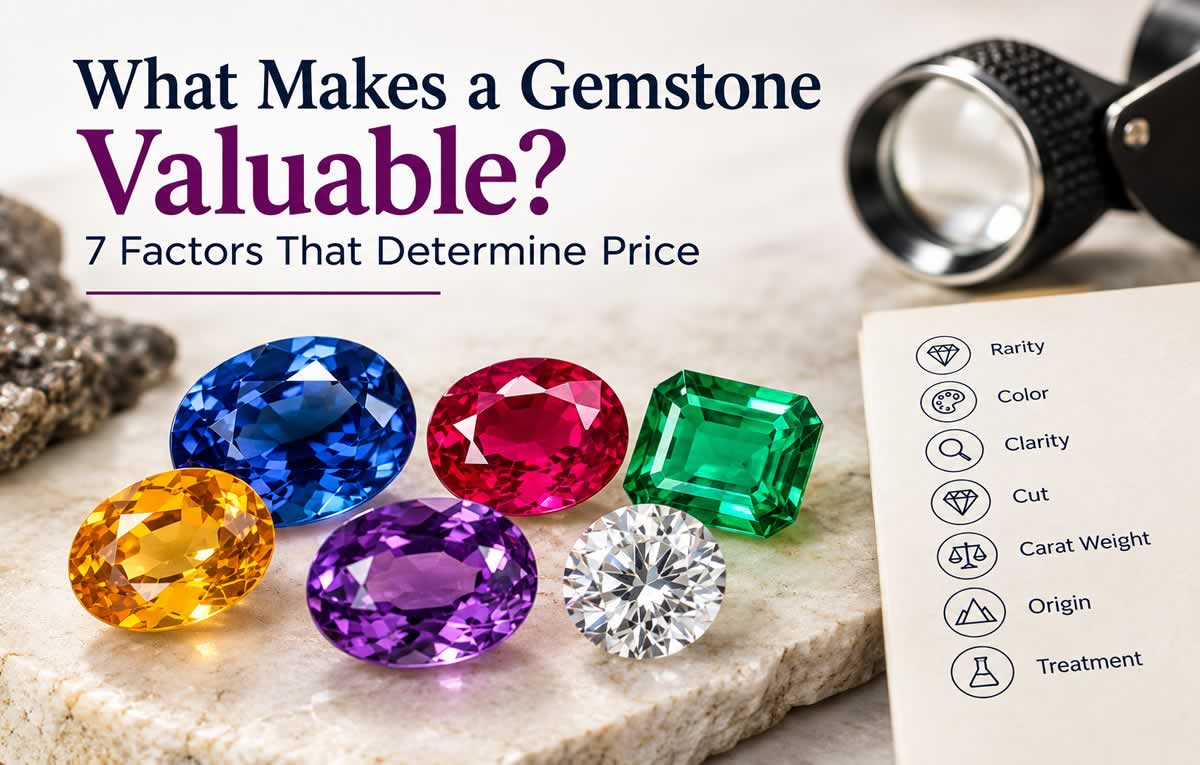
The 7 Main Factors That Determine Gemstone Value
The value of a gemstone is generally influenced by these seven major factors:
Color
Clarity
Cut and quality of cutting
Carat weight and size
Rarity
Origin
Treatment
Other characteristics, such as transparency, optical phenomena, certification and market demand, can also influence the final price.
Let’s examine each factor in detail.
1. Color
Color is one of the most important factors affecting the value of colored gemstones.
For many gemstones, exceptional color can make the difference between an ordinary stone and an extraordinary one.
Gemstone color is commonly evaluated through three basic components:
Hue
Tone
Saturation
Hue
Hue refers to the basic color of the gemstone, such as red, blue, green, yellow or pink.
For example:
Ruby → Red
Sapphire → Blue
Emerald → Green
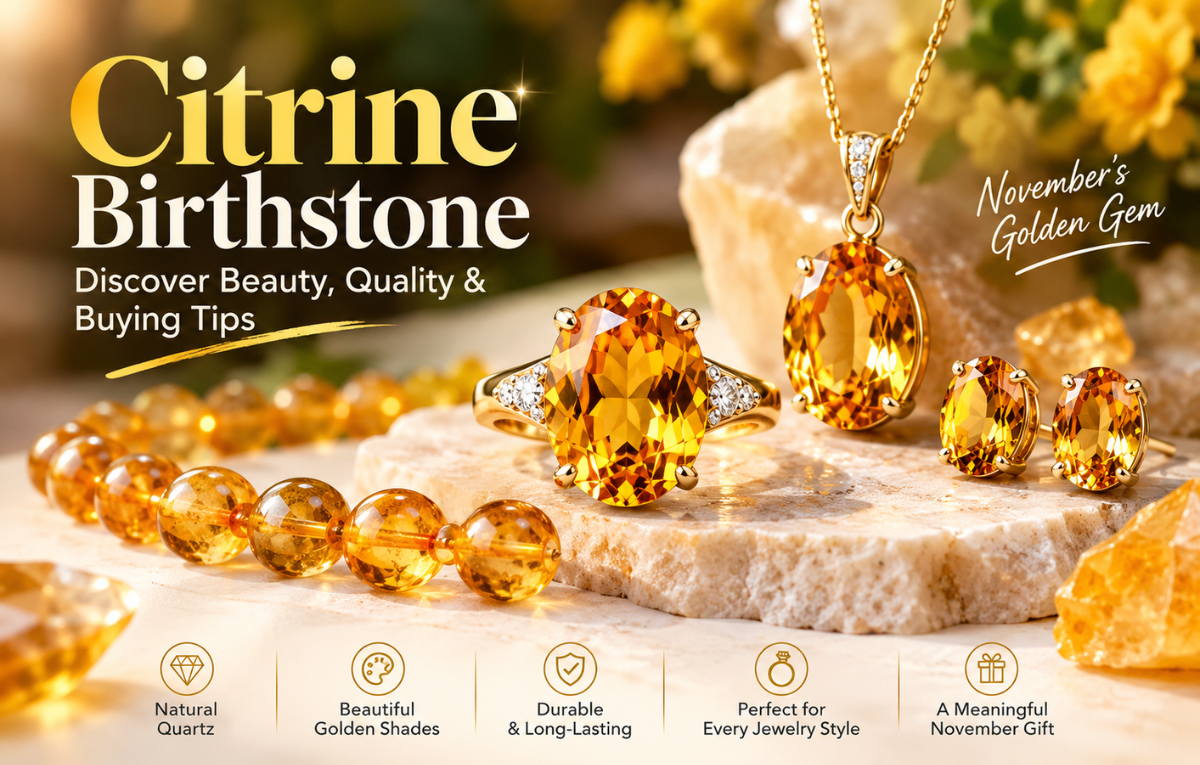
Citrine → Yellow
Amethyst → Purple
However, gemstones can also contain secondary hues.
A sapphire may have violet or greenish secondary tones, while an emerald may display bluish or yellowish influences.
Tone
Tone refers to how light or dark the gemstone appears.
A gemstone that is extremely light may have weak visual impact, while a gemstone that is excessively dark may lose transparency and brilliance.
The ideal tone varies depending on the gemstone.
Saturation
Saturation describes the intensity or strength of the color.
Highly saturated gemstones often have stronger visual appeal.
For example, a vivid blue sapphire may be considerably more desirable than a pale blue sapphire of the same weight.
Why Color Can Dramatically Affect Price
Consider two natural sapphires:
Sapphire A: 5 carats, pale blue
Sapphire B: 3 carats, vivid saturated blue
The smaller sapphire may be worth considerably more because of its superior color.
This demonstrates why carat weight alone does not determine gemstone price.
2. Clarity
Clarity refers to the presence, size, number, location and visibility of inclusions and blemishes inside or on the surface of a gemstone.
Natural gemstones frequently contain inclusions because they form under complex geological conditions.
However, the effect of inclusions varies considerably from one gemstone to another.
Are Inclusions Always Bad?
No.
In some gemstones, inclusions can be expected and accepted as part of the stone’s natural character.
For example, emeralds commonly contain inclusions, while highly transparent sapphires and rubies may be particularly desirable.
Some inclusions can even help prove that a gemstone is natural.
Certain distinctive inclusions can also contribute to the identity or appeal of a gemstone.
Clarity and Gemstone Value
Generally, gemstones with better transparency and fewer distracting inclusions can command higher prices when all other factors are comparable.
However, clarity should always be considered in relation to the gemstone species.
An inclusion that would significantly reduce the value of one gemstone may be relatively acceptable in another.
3. Cut and Cutting Quality
The cut of a gemstone determines how it is shaped and faceted.
Cutting has a major effect on:
Brilliance
Light return
Color appearance
Face-up size
Symmetry
Overall beauty
Popular gemstone cuts include:
Oval
Round
Cushion
Emerald
Pear
Marquise
Princess
Radiant
Trillion
Cabochon
A skilled cutter must balance beauty with weight retention.
Why Is Gemstone Cutting Important?
A poorly cut gemstone may appear dull, overly dark or uneven even if the rough material was excellent.
A well-cut gemstone can maximize the visual qualities of the material.
However, colored gemstones are not always cut according to the same standards used for diamonds.
The cutter may intentionally modify proportions to improve color, preserve weight or accommodate the natural shape of the rough.
Cut vs Carat Weight
A deep gemstone can retain more weight while appearing smaller from the top.
A shallow gemstone may appear larger from the top but potentially have weaker color or light performance.
Therefore, buyers should consider both carat weight and measurements.
4. Carat Weight and Size
Carat is the standard unit used to measure gemstone weight.
One carat equals 0.2 grams.
Carat weight is an important factor in gemstone pricing, but its effect is not always linear.
As a gemstone becomes larger, fine-quality material can become increasingly difficult to find.
This can result in significant increases in price per carat.
Why Large Gemstones Can Be Much More Expensive
Imagine two natural rubies of similar quality:
1-carat ruby
5-carat ruby
The 5-carat ruby may not simply cost five times as much. If fine rubies of that size are exceptionally rare, the price per carat can increase substantially.
This is sometimes described as a size premium.
The size premium varies greatly by gemstone species and quality.
Carat Weight vs Dimensions
Carat weight should not be confused with physical size.
Different gemstones have different densities, meaning two gemstones with the same carat weight may have different dimensions.
When buying a gemstone online, always check:
Carat weight
Length
Width
Depth
This gives you a better understanding of the stone’s actual appearance.
5. Rarity
Rarity is another major factor in determining gemstone value.
A gemstone can be valuable because exceptional examples are difficult to find.
Rarity can relate to:
Limited geological deposits
Scarcity of gem-quality rough
Exceptional color
Large crystal size
Fine clarity
Unusual optical phenomena
Lack of treatment
Historical significance
Rare Does Not Always Mean Expensive
An important point is that rarity alone does not automatically guarantee a high price.
A gemstone can be extremely rare but have limited consumer demand.
The highest values generally occur when rarity and desirability come together.
For example, a rare gemstone with exceptional color, attractive appearance and strong collector demand may command a significant premium.
Examples of Rare Gemstones
Some gemstones known for exceptional rarity include:
Alexandrite
Red beryl
Musgravite
Taaffeite
Fine Paraíba tourmaline
Exceptional demantoid garnet
Certain varieties or qualities of more familiar gemstones can also be extremely rare.
6. Origin
The geographic origin of a gemstone can influence its desirability and price.
Certain locations have become famous for producing exceptional gemstones.
Examples include:
Kashmir → Sapphire
Myanmar → Ruby and sapphire
Colombia → Emerald
Sri Lanka → Sapphire and other gemstones
Brazil → Tourmaline and many other gemstones
Mozambique → Ruby and copper-bearing tourmaline
Historical reputation, geological characteristics and market demand can all contribute to an origin premium.
Does Origin Guarantee Quality?
No.
This is an important distinction.
A gemstone originating from a famous location is not automatically high quality.
A fine gemstone from a less famous locality may be more attractive and more valuable than a lower-quality stone from a historically important source.
When origin is a major part of a gemstone’s claimed value, independent laboratory documentation can be particularly useful.
7. Treatment
Treatment can have a significant effect on gemstone price.
Many gemstones are routinely treated to improve their appearance.
Common treatments include:
Heat treatment
Oiling
Fracture filling
Diffusion
Irradiation
Dyeing
Surface coating
Treatment is not necessarily undesirable. Some treatments are widely accepted throughout the gemstone industry.
However, treatment can influence rarity, durability, care requirements and market value.
Untreated vs Treated Gemstones
An untreated gemstone with exceptional color and quality can be particularly rare.
For some gemstones, the combination of:
Natural + Untreated + Exceptional Color + Fine Clarity + Large Size
can result in a substantial premium.
However, a treated gemstone can still be beautiful and valuable. The key is that treatment should be accurately disclosed.
Other Factors That Can Influence Gemstone Price
The seven factors above are among the most important, but several additional characteristics can affect gemstone value.
Transparency
Transparency describes how easily light passes through a gemstone.
Depending on the gemstone, higher transparency can contribute to desirability.
For transparent gemstones such as sapphire, ruby and aquamarine, good transparency can enhance visual appeal.
However, some gemstones are valued for other characteristics rather than exceptional transparency.
Optical Phenomena
Some gemstones display remarkable optical effects.
Examples include:
Asterism
Chatoyancy
Color change
Play-of-color
Adularescence
Iridescence
These phenomena can make particular gemstones highly desirable.
For example, a fine alexandrite with strong color change can be significantly more valuable than a similar stone without an attractive color-change effect.
Certification
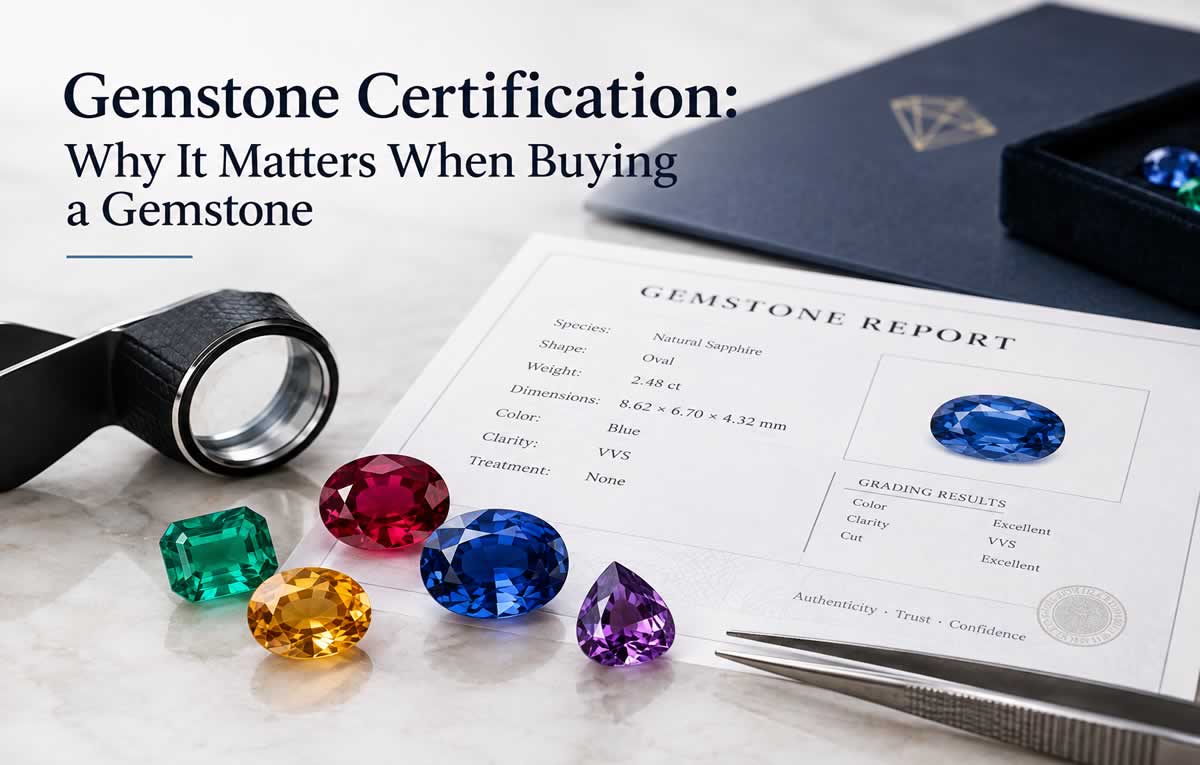
A reputable gemological report can provide useful information about a gemstone’s identity and characteristics.
Depending on the stone and laboratory, a report may address:
Natural or synthetic status
Gemstone identity
Detectable treatments
Measurements
Carat weight
Geographic origin, when determinable
Certification does not automatically increase a gemstone’s intrinsic quality or guarantee its monetary value.
However, independent documentation can provide additional confidence when purchasing an expensive gemstone.
Market Demand
Supply and demand also influence gemstone prices.
A gemstone can be rare, but if few buyers are interested in it, its market price may remain relatively modest.
Conversely, gemstones with strong consumer and collector demand can command higher prices.
Market preferences can change over time as:
Jewelry trends change
New deposits are discovered
Celebrity styles influence demand
Collector interest increases
Availability changes
Therefore, gemstone prices can fluctuate.
How to Compare Gemstone Prices
When comparing two gemstones, avoid comparing them based only on carat weight.
Instead, compare as many characteristics as possible.
Consider:
Factor
What to Compare
Color
Hue, tone and saturation
Clarity
Inclusions and transparency
Cut
Proportions, symmetry and polish
Size
Carat weight and dimensions
Rarity
Availability of comparable material
Origin
Geographic source and documentation
Treatment
Type and extent of treatment
Certification
Laboratory report and conclusions
Demand
Current market interest
The closer two gemstones are in quality and characteristics, the more meaningful a price comparison becomes.
Why Two Gemstones of the Same Type Can Have Different Prices
Suppose you are comparing two natural blue sapphires, both weighing 3 carats.
At first glance, they might appear comparable.
But one may have:
Vivid blue color
Excellent transparency
Attractive proportions
No evidence of heat treatment
Desirable documented origin
The other may have:
Pale or grayish color
More visible inclusions
Less attractive cutting
Heat treatment
No origin determination
Despite having the same gemstone species and carat weight, their values can be dramatically different.
This is why evaluating the complete quality profile is essential.
How to Buy a Valuable Gemstone
If you are shopping for a high-value natural gemstone, use the following checklist.
1. Learn About the Gemstone
Research the typical quality characteristics and treatments for that particular gemstone.
2. Examine the Color
Color is often one of the most important visual characteristics.
3. Check Transparency and Clarity
Look for distracting inclusions and evaluate how light passes through the stone.
4. Review the Cut
Consider symmetry, proportions, polish and overall visual appearance.
5. Check Weight and Measurements
Don’t rely on carat weight alone.
6. Ask About Treatment
Make sure treatment information is clearly disclosed.
7. Consider Certification
For expensive gemstones, an independent gemological report can provide useful additional confidence.
8. Compare Prices
Compare gemstones with similar characteristics rather than comparing only by carat.
9. Buy From a Reputable Seller
A trustworthy gemstone dealer should provide accurate descriptions and clearly disclose relevant characteristics.
Is a More Expensive Gemstone Always Better?
No.
Price and personal preference are not always the same thing.
A collector might prefer a rare gemstone with an unusual inclusion or color zoning, while a jewelry buyer might prioritize transparency and brilliance.
Similarly, one buyer may prefer a vivid green emerald with natural inclusions, while another may prefer a cleaner-looking stone.
The “best” gemstone depends on your purpose, preferences and budget.
Final Thoughts
So, what makes a gemstone valuable?
The answer is a combination of several factors rather than one simple rule.
The seven major factors are:
Color – Often one of the most important characteristics of a colored gemstone.
Clarity – Influences transparency and visual appeal.
Cut – Determines how effectively the gemstone displays its beauty.
Carat Weight – Larger fine-quality stones can command significant premiums.
Rarity – Scarce gem-quality material can be highly desirable.
Origin – Certain documented origins can carry market premiums.
Treatment – Untreated exceptional material can be particularly rare.
Other factors, including transparency, optical phenomena, certification and market demand, can further influence price.
When buying a natural gemstone, don’t focus on just one characteristic. Look at the complete picture.
A beautiful gemstone is the result of nature, geology and skilled craftsmanship. Understanding the factors behind gemstone value allows you to appreciate not only what a gemstone costs, but also why it is worth that price.