Gemstone Certification: Why It Matters When Buying a Gemstone
Buying a gemstone is an exciting experience, especially when you are looking for a beautiful natural stone for a ring, necklace, earrings or collection. However, appearance alone cannot always tell you exactly what you are buying.
A gemstone may look beautiful in photographs or under jewelry-store lighting, but important characteristics such as natural or synthetic origin, treatments, gemstone variety and geographic origin may require professional examination.
This is where gemstone certification becomes important.
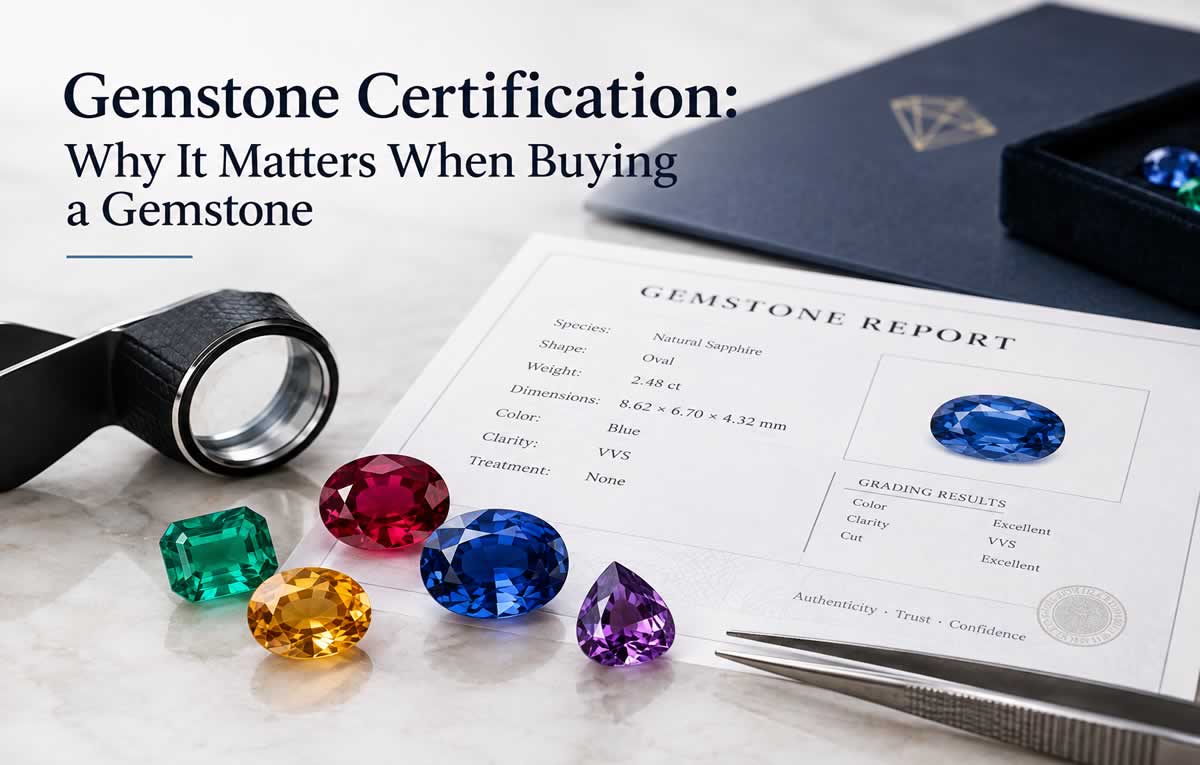
A professional gemstone certificate, more accurately called a gemological report, provides documented information about a gemstone’s identity and characteristics. For valuable natural gemstones, an independent laboratory report can provide additional confidence and help buyers make informed purchasing decisions.
Whether you are buying a natural sapphire, ruby, emerald, aquamarine, tourmaline, garnet or another gemstone, understanding certification can help you avoid costly mistakes.
What Is Gemstone Certification?
Gemstone certification generally refers to documentation issued by a gemological laboratory after examining a gemstone.
A professional report may identify characteristics such as:
- Gemstone species and variety
- Natural or synthetic status
- Detectable treatments
- Color
- Weight
- Measurements
- Transparency
- Certain identifying features
- Geographic origin, when determinable
The exact information depends on the laboratory, gemstone and type of report.
It is important to understand that a gemological report is not necessarily the same thing as an appraisal. A laboratory report primarily identifies and describes the gemstone, while an appraisal estimates monetary value for a particular purpose.
Why Does Gemstone Certification Matter?
The biggest advantage of gemstone certification is that it provides independent documentation about the stone.
This is particularly important when purchasing expensive or rare gemstones.
Certification can help buyers:
- Verify gemstone identity
- Determine whether a stone is natural or synthetic
- Identify detectable treatments
- Confirm reported measurements and weight
- Understand important gemstone characteristics
- Support an origin claim when an origin determination is available
- Make comparisons between gemstones
- Maintain documentation for future resale or insurance purposes
A certificate does not automatically make a gemstone valuable. Instead, it provides information that can help you evaluate what you are actually purchasing.
Natural vs Synthetic Gemstones
One of the most important reasons to obtain a gemstone report is to determine whether a gemstone is natural or synthetic.
A natural gemstone forms through geological processes in nature.
A synthetic gemstone is produced by humans in a laboratory or manufacturing environment but has essentially the same chemical composition and crystal structure as its natural counterpart.
Synthetic gemstones can be beautiful and useful, but their market value can differ substantially from comparable natural gemstones.
For expensive purchases, knowing whether the gemstone is natural or synthetic is therefore extremely important.
Understanding Gemstone Treatments
Many gemstones are treated to improve their color, clarity, transparency or overall appearance.
Common gemstone treatments include:
- Heat treatment
- Fracture filling
- Oiling
- Diffusion
- Irradiation
- Surface coating
- Dyeing
Treatment is not necessarily a negative characteristic. Many treatments are widely accepted in the gemstone industry.
However, treatment can influence rarity, value and care requirements.
For example, heat treatment is common in many sapphires and rubies, while emeralds are commonly treated with oils or other substances to improve apparent clarity.
A gemological report can help identify detectable treatments and provide important information for the buyer.
Can a Certificate Prove a Gemstone Is Natural?
A report from a reputable gemological laboratory can provide an expert opinion regarding whether a gemstone is natural or synthetic based on laboratory examination.
However, no report should be interpreted as a guarantee of monetary value.
The report is primarily evidence about the gemstone’s identity and characteristics. Its conclusions depend on the testing methods and observations available to the laboratory.
For expensive gemstones, buying a stone accompanied by a report from a reputable and appropriately equipped laboratory can significantly improve transparency.
What Information Is Usually Included in a Gemstone Report?
The exact format varies between laboratories, but a gemstone report may include several important details.
Gemstone Identification
The report may identify the mineral species and, where appropriate, its variety.
For example, a report might identify a gemstone as:
- Natural corundum, variety sapphire
- Natural corundum, variety ruby
- Natural beryl, variety emerald
- Natural tourmaline
- Natural quartz
This information helps establish what the gemstone actually is.
Weight
Gemstone weight is generally expressed in carats.
One carat equals 0.2 grams.
For valuable gemstones, accurately documented carat weight is an important part of the stone’s identification and description.
Measurements
A report can also document the gemstone’s dimensions, usually expressed in millimeters.
Measurements are particularly useful when comparing a gemstone with photographs, jewelry settings or previous descriptions.
Color
Color descriptions can help communicate the gemstone’s visual appearance.
Depending on the gemstone and laboratory, the report may provide a more detailed description of hue, tone and saturation.
Color can have a major influence on the value of colored gemstones.
Treatment
One of the most important sections of a gemstone report concerns detectable treatments.
The laboratory may identify treatments such as:
- Heat
- Filling
- Oiling
- Diffusion
- Irradiation
- Coating
The report may also indicate when no evidence of certain treatments was observed.
Origin
Some laboratories offer geographic origin opinions for certain gemstones.
Possible origin determinations can be particularly important for gemstones such as ruby, sapphire and emerald.
However, geographic origin determination is not always possible.
A laboratory may sometimes conclude that the origin is inconclusive because the gemstone’s characteristics do not provide sufficient evidence for a reliable determination.
Is a Gemstone Certificate the Same as a Gemstone Appraisal?
No.
This distinction is very important.
A gemological report describes and identifies a gemstone.
An appraisal provides an estimated monetary value for a specific purpose.
For example, an appraisal may be prepared for:
- Insurance
- Estate planning
- Replacement value
- Financial documentation
- Certain resale considerations
A laboratory report generally does not mean that the gemstone is worth a specific amount of money.
In other words:
Certificate/report = What is the gemstone?
Appraisal = What may the gemstone be worth for a particular purpose?
Why Certification Is Especially Important for Expensive Gemstones
The more valuable the gemstone, the more important independent documentation can become.
Imagine buying a large natural sapphire advertised as untreated and originating from a prestigious locality.
Those claims could have a major influence on price.
Without appropriate documentation, a buyer may have difficulty independently verifying those characteristics.
A laboratory report can provide additional evidence and transparency.
For high-value gemstones, certification is therefore an important part of the purchasing process.
Which Gemstones Should Be Certified?
Certification can be useful for many gemstones, but it is especially valuable for expensive, rare or heavily treated materials.
Consider obtaining a report for:
- Fine sapphire
- Fine ruby
- Fine emerald
- Alexandrite
- Paraíba tourmaline
- Rare spinel
- Fine colored diamonds
- Exceptional tourmaline
- Rare garnets
- High-value collector gemstones
Certification can also be useful when a gemstone is being purchased specifically as a collectible or potential long-term asset.
Certification for Sapphires
Sapphires are among the gemstones for which certification can be particularly useful.
A report may provide information about:
- Natural or synthetic status
- Treatment
- Color
- Measurements
- Weight
- Geographic origin, when determinable
For example, claims such as untreated Kashmir sapphire, Burmese sapphire or Ceylon sapphire can significantly affect market interest.
For important purchases, independent laboratory documentation can help support such claims.
Certification for Rubies
Ruby is another gemstone where treatment and origin can have a significant influence on value.
A report may help determine whether a ruby is:
- Natural
- Synthetic
- Heated
- Fracture-filled
- Subject to other detectable treatments
Origin determination may also be available for some rubies.
For exceptionally valuable ruby, independent laboratory documentation is particularly important.
Certification for Emeralds
Emeralds frequently contain inclusions and are commonly subjected to clarity enhancement.
A report can help buyers understand whether an emerald is natural and whether detectable clarity enhancement is present.
When purchasing an expensive emerald, information about treatment can be very important when comparing stones.
Certification for Other Colored Gemstones
Certification is not limited to ruby, sapphire and emerald.
It can also be useful for:
- Aquamarine
- Tourmaline
- Spinel
- Garnet
- Topaz
- Tanzanite
- Alexandrite
- Peridot
- Citrine
- Kunzite
- Opal
- Rare collector gemstones
Different gemstones require different testing methods, so the laboratory’s expertise and equipment should be considered.
How to Choose a Reliable Gemstone Laboratory
Not all reports carry the same level of recognition in every market.
When purchasing an expensive gemstone, consider the laboratory’s:
- Reputation
- Gemological expertise
- Testing capabilities
- Independence
- Report format
- Verification system
- Experience with the specific gemstone
- Recognition within the relevant gemstone market
For particularly valuable gemstones, it can be worthwhile to research the laboratory before relying on its report.
Check the Certificate Number
Many modern gemstone reports contain a unique report or certificate number.
If the laboratory provides an online verification system, use it to confirm that:
- The report number exists
- The gemstone description matches
- Weight and measurements are consistent
- Treatment information matches
- Other identifying details correspond to the physical gemstone
This is a simple but important step when buying a certified gemstone.
Does a Certificate Guarantee Gemstone Value?
No.
This is one of the most common misunderstandings about gemstone certification.
A certificate does not guarantee that a gemstone is worth a particular amount.
Gemstone value depends on numerous factors, including:
- Color
- Clarity
- Cut
- Carat weight
- Rarity
- Origin
- Treatment
- Demand
- Market conditions
- Overall beauty
Two natural sapphires with similar laboratory reports can have very different market values because their color, clarity, proportions and visual appeal may differ significantly.
Does Certification Increase Gemstone Value?
Certification itself does not automatically increase the intrinsic value of a gemstone.
However, a credible independent report can increase buyer confidence and make it easier to communicate important characteristics.
For a valuable natural gemstone, documentation may also make the stone easier to compare, resell or insure.
Therefore, certification can have an indirect commercial benefit even though the certificate itself is not what creates the gemstone’s value.
How Certification Helps When Buying Online
Buying gemstones online has become increasingly popular.
Online shopping provides access to gemstones from sellers around the world, but buyers cannot physically examine the stone before purchasing it.
A laboratory report can provide useful independent information about the gemstone.
When buying a certified gemstone online:
- Read the complete report.
- Verify the report number if an online system is available.
- Compare the report with the seller’s description.
- Check the gemstone’s measurements and carat weight.
- Review treatment information carefully.
- Look for clear photographs and videos.
- Understand the seller’s return policy.
- Buy from a reputable gemstone dealer.
Certification is therefore particularly useful when the buyer and gemstone are separated by thousands of miles.
Certificate vs Seller’s Description
A seller’s description and a laboratory report serve different purposes.
A reputable seller should accurately describe the gemstone and disclose relevant information.
However, an independent laboratory report provides an additional layer of verification.
For example, a seller may describe a stone as:
Natural, untreated blue sapphire
An appropriate laboratory report can provide independent information regarding whether the stone is natural and whether detectable treatment is present.
For significant purchases, this additional documentation can be extremely valuable.
What Should You Check Before Buying a Certified Gemstone?
Before purchasing a gemstone with a certificate, compare the physical stone with the report.
Check:
1. Carat Weight
Does the gemstone’s weight match the report?
2. Measurements
Do the dimensions correspond?
3. Shape and Cut
Does the gemstone shown in the photographs match the report description?
4. Color
Does the reported color description appear consistent with the actual gemstone?
5. Treatment
Read the treatment section carefully.
6. Natural or Synthetic Status
Make sure the report identifies the gemstone appropriately.
7. Report Number
Verify the report when the laboratory offers an online verification service.
Common Mistakes Buyers Make
Even experienced gemstone buyers can make mistakes when purchasing valuable stones.
Mistake 1: Assuming Every Certificate Is Equal
Laboratories differ in reputation, expertise and testing capabilities.
Mistake 2: Looking Only at the Certificate
A report does not replace careful examination of the gemstone itself.
Mistake 3: Assuming Certified Means Valuable
Certification establishes characteristics; it does not automatically establish a high market value.
Mistake 4: Ignoring Treatment
Always check whether treatment is present and what type of treatment has been identified.
Mistake 5: Buying Based Only on Origin
Origin can be important, but quality remains critical.
Mistake 6: Not Verifying the Report
If online verification is available, use it.
Should You Buy Certified or Non-Certified Gemstones?
There is no universal rule that every gemstone must be certified.
For inexpensive commercial gemstones, a laboratory report may not be economically necessary.
For expensive, rare or investment-grade gemstones, independent certification is much more important.
A practical approach is:
Lower-value gemstone → Certification may be optional
Moderately valuable gemstone → Certification can provide useful reassurance
High-value or rare gemstone → Independent laboratory report is strongly recommended
Final Thoughts
Gemstone certification is an important tool for buyers who want greater confidence when purchasing natural gemstones.
A credible gemological report can provide information about gemstone identity, natural or synthetic status, detectable treatments, measurements, weight and, when possible, geographic origin.
However, certification should be viewed as one part of the buying process rather than a guarantee of quality or price.
When purchasing an expensive gemstone, combine laboratory documentation with careful evaluation of color, clarity, cut, transparency, carat weight, treatment and overall beauty.
Whether you are buying a natural sapphire, ruby, emerald, tourmaline, alexandrite or another rare gemstone, independent documentation can help you understand exactly what you are purchasing.
A beautiful gemstone is an investment in natural beauty, craftsmanship and geological history. The right certification helps ensure that the story behind that gemstone is supported by reliable gemological evidence.