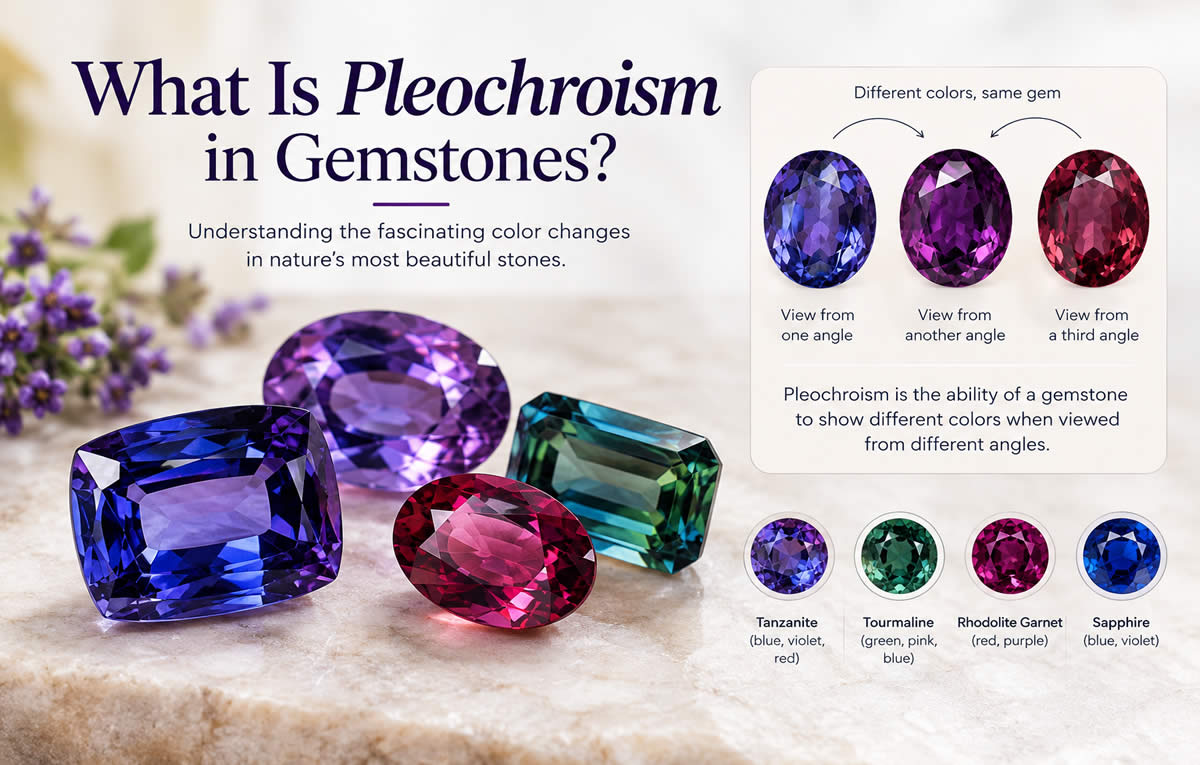
Gemstones can display many fascinating optical characteristics that make them look different when viewed from different directions. One of these characteristics is pleochroism in gemstones, an optical phenomenon that causes a gemstone to show different colors or different intensities of color depending on the direction from which it is viewed.
Pleochroism is particularly important when evaluating colored gemstones because it can influence their appearance, cutting decisions, body color, and overall visual appeal.
Some gemstones may appear blue from one direction and slightly greenish-blue from another. Others may show different shades of brown, yellow, green, purple, or red depending on the viewing direction.
Understanding pleochroism in gemstones can help gemstone buyers, collectors, jewelry designers, and enthusiasts better understand why some stones change appearance when they are rotated.
What Is Pleochroism?
Pleochroism is an optical phenomenon in which a gemstone can show different colors or different color intensities when viewed along different crystallographic directions.
The word comes from Greek roots meaning “many colors.”
This phenomenon occurs because light can be absorbed differently depending on its direction of travel through certain anisotropic gemstones.
In simple terms, a pleochroic gemstone may not absorb all wavelengths of visible light equally in every direction. As the gemstone is rotated, the colors or color intensities that reach the observer can change.
For example, a gemstone might display:
Blue in one direction
Greenish-blue in another direction
A darker blue from a third direction
The colors do not necessarily change because the gemstone is physically changing. Instead, the optical properties of the crystal cause different colors or intensities to be visible from different directions.
Why Does Pleochroism Occur?
To understand pleochroism in gemstones, it is helpful to understand how light interacts with crystals.
Some gemstones are anisotropic, meaning that their optical properties vary depending on the direction through the crystal.
In these gemstones, light traveling in different directions can experience different levels of absorption. As a result, different wavelengths of light may be absorbed more strongly in one direction than another.
The remaining light reaches the observer with a different color or intensity.
This directional difference in absorption produces pleochroism.
Is Pleochroism the Same as Color Change?
No. Pleochroism and color-change phenomena are different.
Pleochroism occurs when a gemstone shows different colors or color intensities depending on the direction of observation through the crystal.
A color-change gemstone, on the other hand, changes its apparent color primarily because the lighting source changes.
For example:
Pleochroism: The gemstone is rotated under the same light source, and different colors can be observed from different directions.
Color Change: The gemstone is viewed under different types of lighting, such as daylight and incandescent light, and its apparent color changes.
These two phenomena can sometimes be confused because both can produce noticeable changes in gemstone appearance.
What Is Dichroism?
Dichroism is a specific type of pleochroism found in uniaxial anisotropic gemstones.
A dichroic gemstone can show two different principal colors or color intensities when examined along different optical directions.
Some gemstones are described as strongly dichroic, while others have weak dichroism that may be difficult to observe without proper equipment.
Examples of gemstones that can show dichroism include:
Tourmaline
Tanzanite
Sapphire
Ruby
Aquamarine
The exact colors observed depend on the gemstone’s species, variety, chemistry, and crystallographic orientation.
What Is Trichroism?
Trichroism is another form of pleochroism.
It occurs in certain biaxial gemstones that can show three different principal colors or color intensities when viewed along the appropriate crystallographic directions.
Trichroism can be particularly interesting in gemstones because the stone may exhibit three distinct optical responses.
Gemstones that can display trichroism include:
Tanzanite
Andalusite
Iolite
Some varieties of tourmaline
Certain other biaxial gemstones
The degree of visible color separation varies considerably from one gemstone to another.
Uniaxial vs. Biaxial Gemstones
The optical structure of a gemstone helps determine the type of pleochroism it can display.
Uniaxial Gemstones
Uniaxial gemstones have one optic axis and can exhibit two principal optical directions.
They can therefore display dichroism, with two different colors or color intensities.
Examples include certain varieties of:
Tourmaline
Corundum, including sapphire and ruby
Beryl, including aquamarine and emerald
Biaxial Gemstones
Biaxial gemstones have two optic axes and can exhibit three principal optical directions.
These gemstones may show trichroism.
Examples include:
Tanzanite
Andalusite
Iolite
Peridot
Which Gemstones Show Pleochroism?
Many colored gemstones can display some degree of pleochroism, although the strength and visibility can vary significantly.
Tanzanite
Tanzanite is one of the most famous examples of a strongly pleochroic gemstone.
It can display different combinations of blue, violet, and reddish or brownish tones depending on the direction of observation.
Because of this strong pleochroism, cutting orientation is particularly important for tanzanite.
A cutter must decide how to orient the rough material to produce the most desirable face-up color.
Tourmaline
Tourmaline can display noticeable pleochroism, especially in strongly colored varieties.
A green tourmaline, for example, may show differences in color intensity when viewed from different directions.
Some tourmalines can display relatively strong directional color differences, making orientation an important consideration during cutting.
Sapphire
Sapphire can show pleochroism, particularly in strongly colored blue varieties.
Blue sapphire may display differences between blue and greenish-blue or violet-blue tones depending on its crystallographic direction.
The cutter can use orientation to maximize the most attractive blue color and minimize undesirable secondary tones.
Ruby
Ruby can also exhibit pleochroism.
Depending on the material, ruby may display different shades or intensities of red along different directions.
Good cutting can help present the more attractive red appearance when the stone is viewed face-up.
Aquamarine
Aquamarine can display weak to moderate pleochroism.
Depending on its crystallographic orientation, it may show differences between blue and blue-green tones.
Because aquamarine is commonly valued for a clean blue appearance, cutting orientation can influence the final face-up color.
Emerald
Emerald can also exhibit pleochroism.
The directional differences may be subtle, but they can contribute to variations in green appearance.
As with other colored gemstones, the cutter considers the crystal orientation when planning the cut.
Iolite
Iolite is well known for strong pleochroism.
It may display different shades of blue, violet, gray, or yellowish tones depending on the viewing direction.
This strong directional color behavior is one of the reasons iolite is sometimes called a “water sapphire,” although it is not actually sapphire.
Andalusite
Andalusite is another excellent example of a strongly pleochroic gemstone.
It can display combinations of green, brown, yellow, and reddish-brown colors depending on the direction of observation.
Its pleochroism can create an attractive multicolored appearance in a well-cut gemstone.
Peridot
Peridot can show weak to moderate pleochroism, generally involving different intensities of green and yellow-green.
Although its pleochroism is not always dramatic, it can influence the appearance of the finished gemstone.
How Is Pleochroism Identified?
Pleochroism can sometimes be observed simply by rotating a gemstone under a suitable light source.
However, professional gemologists use specialized instruments to evaluate it more accurately.
One of the most useful tools is a dichroscope.
A dichroscope separates the two polarized light rays traveling through an anisotropic gemstone and allows the observer to compare their colors.
Depending on the gemstone, the instrument can reveal:
Two different colors
Two different intensities of the same color
Three principal colors in strongly trichroic materials
Pleochroism is therefore an important diagnostic characteristic in gemological examination.
How to Observe Pleochroism at Home
You can sometimes observe pleochroism without professional equipment.
Step 1: Use Good Lighting
Place the gemstone under bright, neutral lighting.
Avoid relying on extremely warm or colored light sources because they can make color differences harder to interpret.
Step 2: Hold the Gemstone Carefully
Hold the gemstone using tweezers or carefully between your fingers.
Avoid touching the polished surfaces unnecessarily because fingerprints and oils can affect the appearance.
Step 3: Rotate the Gemstone
Slowly rotate the gemstone while observing it from different directions.
Pay attention to changes in:
Hue
Color intensity
Saturation
Secondary colors
Step 4: Compare Different Directions
If the gemstone appears noticeably different as it rotates, it may have some degree of pleochroism.
However, reflections, facet arrangement, transparency, and lighting can also cause apparent color differences.
For reliable identification, professional testing is recommended.
How Does Pleochroism Affect Gemstone Cutting?
Pleochroism can have a major impact on the way a gemstone is cut.
A rough crystal may contain different color directions. The cutter must decide how to orient the finished gemstone to achieve the most attractive face-up appearance.
The objective is often to:
Maximize the desirable color
Reduce undesirable secondary colors
Improve overall color saturation
Optimize the gemstone’s visual appearance
Minimize unwanted color zoning
This is especially important for strongly pleochroic gemstones such as tanzanite, iolite, and some tourmalines.
Can Pleochroism Increase Gemstone Value?
Pleochroism does not automatically make a gemstone more valuable.
Its effect on value depends on the gemstone species and whether the phenomenon improves or reduces the stone’s appearance.
If pleochroism contributes attractive secondary colors or helps create an interesting visual character, collectors may appreciate it.
However, if a gemstone has a strong undesirable color direction that makes the face-up stone appear too dark or unattractive, pleochroism may be a disadvantage.
Therefore, the quality and appearance of the finished gemstone are more important than simply having strong pleochroism.
Pleochroism and Gemstone Color
Color is one of the most important factors in evaluating many colored gemstones.
Pleochroism can influence how that color appears to the observer.
For example, a blue gemstone with a strong greenish secondary color may appear very different depending on its orientation.
This means that gemstone buyers should evaluate color face-up, rather than judging a rough crystal solely from one side.
The cutter’s skill is particularly important when working with strongly pleochroic material.
Pleochroism in Rough Gemstones
Pleochroism can be especially noticeable in rough gemstone crystals.
A rough crystal may show different colors along different crystal directions. Experienced cutters study these characteristics before deciding how to orient and cut the material.
For collectors purchasing rough gemstones, pleochroism can be an interesting identifying feature.
However, rough material should be evaluated carefully because its final color and appearance after cutting may be significantly different from what is visible on the rough crystal.
Pleochroism vs. Dichroism vs. Trichroism
These terms are closely related.
Term
Meaning
Pleochroism
General phenomenon of directional color differences
Dichroism
Two principal colors or color intensities
Trichroism
Three principal colors or color intensities
Color Change
Color changes primarily with different lighting conditions
Understanding these differences makes it easier to discuss gemstone optical properties accurately.
Is Pleochroism a Sign of a Natural Gemstone?
Pleochroism can be a useful gemological characteristic, but it does not by itself prove that a gemstone is natural.
Natural, synthetic, and treated materials can have overlapping optical characteristics.
Professional identification may involve examining:
Refractive index
Birefringence
Specific gravity
Pleochroism
Inclusions
Absorption spectrum
Fluorescence
Growth structures
Treatment indicators
Chemical composition
For valuable gemstones, a reputable gemological laboratory report provides much stronger evidence of identity and treatment status.
Does Every Gemstone Have Pleochroism?
No.
Pleochroism occurs primarily in anisotropic gemstones. Isotropic materials, such as diamond in the cubic crystal system, do not display pleochroism in the same way because their optical properties are directionally uniform.
Some gemstones are also so weakly pleochroic that the effect may not be noticeable to the unaided eye.
Therefore, the absence of obvious pleochroism does not necessarily indicate a problem with a gemstone.
Why Gemstone Buyers Should Understand Pleochroism
Understanding pleochroism in gemstones can help buyers make better decisions when comparing colored gemstones.
It can explain why:
A gemstone appears different when rotated
A stone has different color intensities in different directions
Some gemstones require careful cutting orientation
The same rough crystal can produce different face-up colors
Some gemstones look darker from certain angles
Gemologists use instruments to examine directional color
For collectors and jewelry buyers, recognizing pleochroism can provide a deeper understanding of how a gemstone’s natural crystal structure influences its appearance.
Tips for Buying Pleochroic Gemstones
If you are purchasing a strongly pleochroic gemstone, consider these factors:
1. View the Gemstone Face-Up
The most important appearance is usually how the gemstone looks when set in jewelry.
2. Rotate the Stone
Examine the gemstone from multiple directions to understand its color behavior.
3. Check for Unwanted Secondary Colors
Strong pleochroism can sometimes introduce colors that reduce the attractiveness of the stone.
4. Examine the Cut
A skilled cut can take advantage of desirable color directions and minimize undesirable ones.
5. Consider Lighting
Evaluate the gemstone under more than one suitable light source when possible.
6. Ask About Treatment
If you are buying an expensive gemstone, ask whether it has been treated and request documentation when appropriate.
7. Consider Certification
For high-value gemstones, an independent gemological report can help confirm identity, treatment, and other important characteristics.
Final Thoughts on Pleochroism in Gemstones
Pleochroism in gemstones is a fascinating optical phenomenon caused by directional differences in the way certain crystals interact with light. Instead of having exactly the same appearance from every direction, pleochroic gemstones can show different colors or different intensities of color as they are rotated.
Tanzanite, tourmaline, sapphire, ruby, aquamarine, iolite, and andalusite are among the gemstones where pleochroism can be observed.
For gemstone cutters, pleochroism is an important consideration because crystal orientation can influence the final face-up color. For buyers and collectors, understanding pleochroism makes it easier to appreciate why some gemstones display different shades when viewed from different directions.
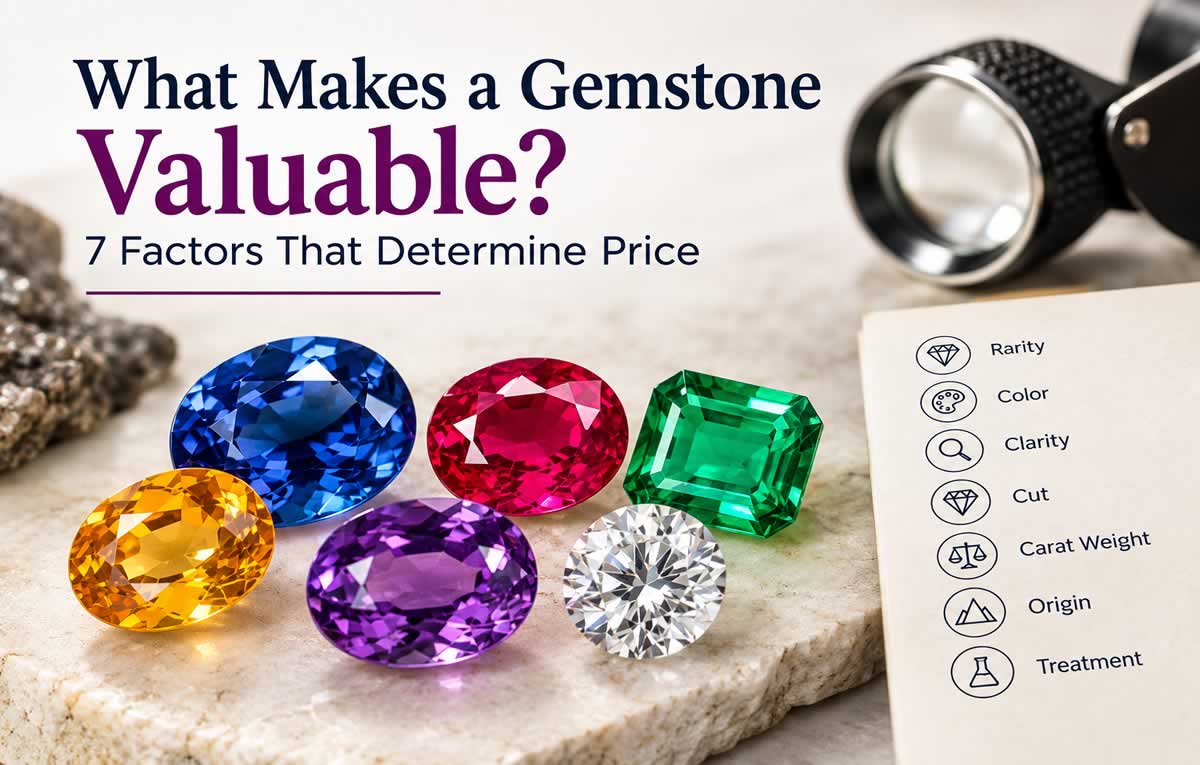
Most importantly, pleochroism should be considered together with color, clarity, transparency, cut, carat weight, treatment, origin, and other gemological characteristics.
When properly understood, pleochroism in gemstones is not simply a technical property—it is part of what makes natural colored gemstones so visually fascinating and unique.








 Cushion Cut Gemstones
 Emerald Cut Gemstones
 Oval Shape Gemstones
 Asscher Cut Gemstones
 Pear Shaped Gemstones
 Round Gemstones
 Heart Shape Gemstones
 Elongated Cushion Cut
 Marquise Gemstones
 Princess Cut Gemstones
 Blue Gemstones
 Green Gemstones
 Purple Gemstones
 Red Gemstones
 Yellow Gemstones
 Orange Gemstones
 Pink Gemstones
 Black Gemstones
 Brown Gemstones
 Gray Gemstones
 Multi Color Gemstones
 Bi Color Gemstones
 White Gemstones
 Colored Gemstones
 January Birthstones
 February Birthstones
 March Birthstones
 April Birthstones
 May Birthstones
 June Birthstones
 July Birthstones
 August Birthstones
 September Birthstones
 October Birthstones
 November Birthstones
 December Birthstones