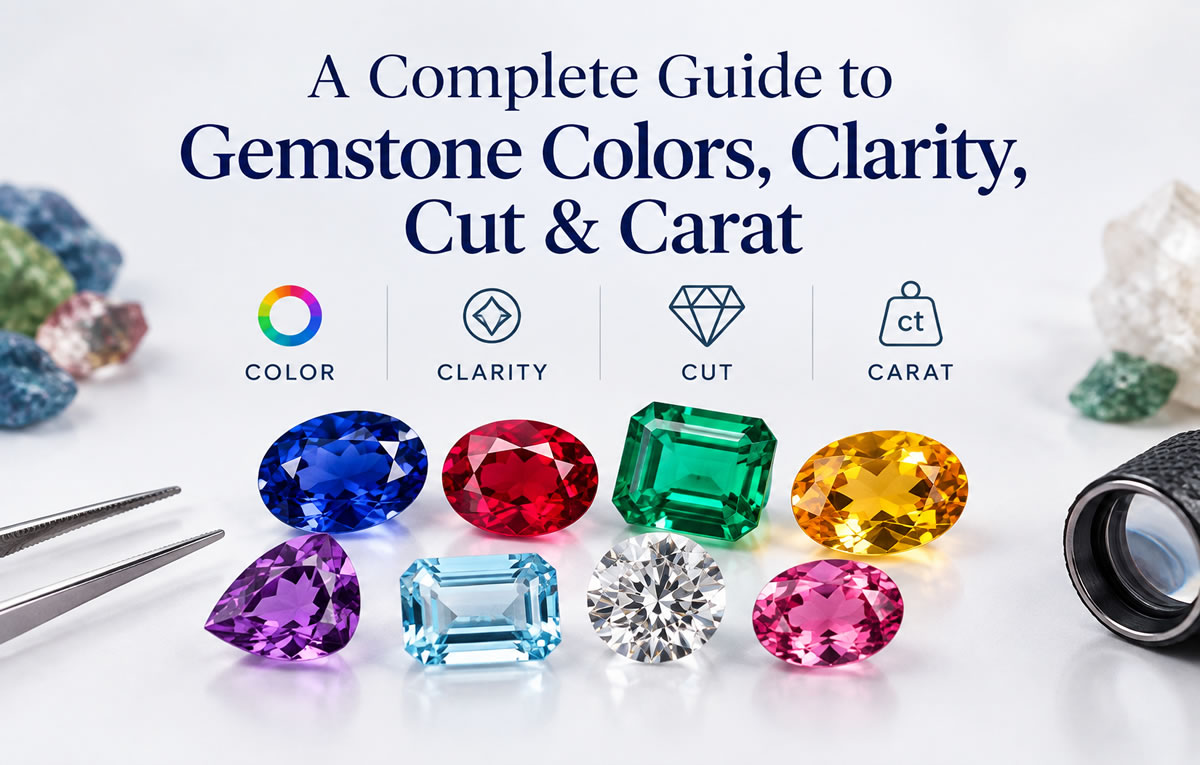
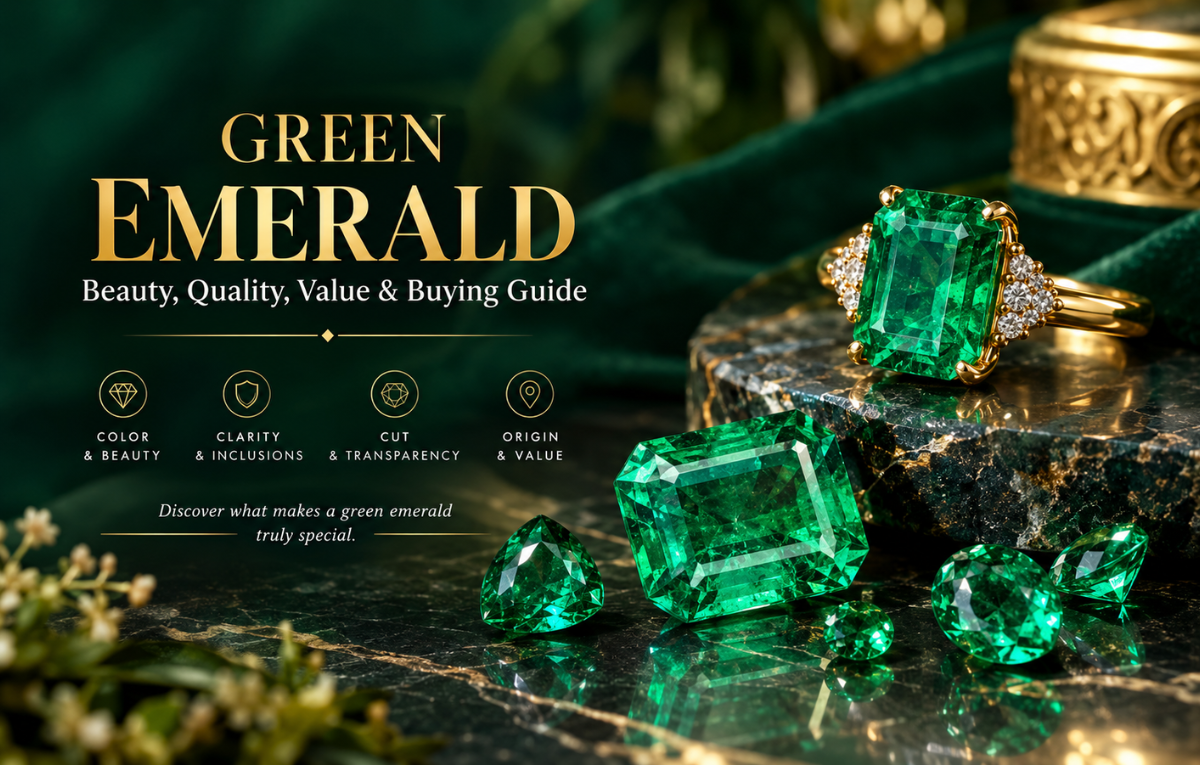
A Complete Guide to Gemstone Colors, Clarity, Cut & Carat
When buying a natural gemstone, four important factors can have a major influence on its appearance, desirability, and value: color, clarity, cut, and carat weight. Understanding these characteristics can help you make a more informed decision when purchasing a loose gemstone or choosing a stone for a jewelry piece.
Unlike diamonds, where the traditional 4Cs are widely standardized, colored gemstones are evaluated somewhat differently. Gemstone colors, clarity, cut and carat all matter, but their importance can vary depending on the particular gemstone.
A vivid sapphire, for example, may be valued primarily for its exceptional color, while inclusions in an emerald can sometimes be accepted as part of the stone’s natural character. Therefore, understanding each factor individually—and how they work together—is essential for anyone interested in natural gemstones.
What Are the 4Cs of Gemstones?
The four characteristics discussed in this guide are:
- Color – The hue, tone, and saturation of a gemstone.
- Clarity – The presence, size, type, and location of internal or surface features.
- Cut – How the gemstone has been shaped and faceted to enhance its appearance.
- Carat – The weight of the gemstone.
These four factors can influence the overall beauty and market value of a gemstone. However, they should not be considered in isolation. Origin, treatment, rarity, durability, certification, and demand can also have a significant impact on price.
Understanding Gemstone Color
For most colored gemstones, color is one of the most important characteristics. A gemstone with an attractive, vivid, and well-balanced color can be considerably more desirable than a larger gemstone with weak or overly dark color.
Gemstone color is generally evaluated through three primary components: hue, tone, and saturation.
Hue
Hue refers to the basic color that we see in a gemstone.
Examples include:
- Blue
- Green
- Red
- Yellow
- Pink
- Purple
- Orange
Some gemstones can display secondary hues. For example, a sapphire may have blue with a slight violet component, while an emerald may show a bluish-green appearance.
The ideal hue depends on the gemstone and personal preference.
Tone
Tone describes how light or dark the gemstone appears.
A gemstone can range from very light to very dark. In many gemstones, a medium to medium-dark tone can provide an attractive balance between color intensity and brightness.
However, the ideal tone is not the same for every gemstone.
For example, a vivid blue sapphire may be highly desirable with a strong medium tone, while a very dark stone may appear almost black and lose some of its visual brilliance.
Saturation
Saturation describes the intensity or strength of the gemstone’s color.
A gemstone with strong saturation generally has a more vivid and noticeable color. Weakly saturated gemstones may appear pale, grayish, or washed out.
When evaluating gemstone colors, clarity, cut and carat, color should generally be considered first for strongly color-dependent gemstones.
Why Is Gemstone Color Important?
Color can dramatically affect the personality of a gemstone.
Two gemstones with identical carat weights and similar clarity may have very different values because one has a more attractive color.
For many buyers, the ideal gemstone has:
- Attractive hue
- Balanced tone
- Strong saturation
- Good brightness
- Even color distribution
Natural gemstones can also display interesting color characteristics such as zoning, color gradients, or pleochroism. These features can contribute to a gemstone’s uniqueness.
Understanding Gemstone Clarity
Gemstone clarity refers to the internal and external characteristics visible within or on the surface of a gemstone.
These characteristics are commonly known as inclusions and blemishes.
Unlike diamonds, colored gemstones are not necessarily expected to be completely free of inclusions. In fact, some natural gemstones commonly contain inclusions because of the geological conditions under which they formed.
What Are Gemstone Inclusions?
Inclusions are materials or structures located inside a gemstone.
They can include:
- Mineral crystals
- Needles
- Liquid-filled cavities
- Gas bubbles
- Growth structures
- Internal fractures
- Clouds
- Other natural features
The type and quantity of inclusions can vary significantly between different gemstones.
For example, emeralds frequently contain visible inclusions. These are sometimes referred to as the stone’s natural “jardin,” or garden-like appearance.
Does Better Clarity Always Mean Higher Value?
Not necessarily.
For some gemstones, high clarity is extremely desirable. For others, inclusions may be expected and acceptable.
An exceptionally clean ruby or sapphire can be rare and valuable. However, an emerald with absolutely no visible inclusions can be exceptionally unusual.
Therefore, clarity should always be judged according to the specific gemstone variety.
The location of inclusions is also important. An inclusion directly beneath the table of a faceted gemstone may be much more noticeable than one near the edge.
Understanding Gemstone Cut
The cut of a gemstone determines how it has been shaped and polished. It can have a major effect on brilliance, sparkle, color appearance, and overall beauty.
A well-cut gemstone can make excellent use of the material and light entering the stone.
Common gemstone cuts include:
- Round
- Oval
- Cushion
- Emerald
- Pear
- Marquise
- Princess
- Asscher
- Radiant
- Trillion
- Cabochon
Different cuts are suitable for different gemstones and styles.
Faceted Gemstones
Faceted gemstones have multiple polished surfaces known as facets.
These facets are designed to interact with light and can produce:
- Brilliance
- Sparkle
- Brightness
- Color reflection
- Visual depth
The quality of faceting is important. Poor proportions or facet alignment can cause a gemstone to appear dull or uneven.
Cabochon Gemstones
A cabochon is generally polished with a smooth, curved surface rather than traditional flat facets.
Cabochon cutting is particularly popular for gemstones that display phenomena or visual effects.
Examples include certain varieties of:
- Star sapphire
- Star ruby
- Moonstone
- Opal
- Cat’s-eye gemstones
The best cut depends on the gemstone’s optical properties, color, clarity, and intended use.
Why Is Cut Important?
Cut can influence how a gemstone looks even when its color and clarity are excellent.
A well-proportioned gemstone can appear brighter and more attractive, while a poorly cut stone may look dark, dull, or uneven.
When buying a loose gemstone, don’t focus only on the shape. Examine the proportions, symmetry, polish, facet arrangement, and overall visual appearance.
Understanding Gemstone Carat Weight
Carat is a unit of weight used for gemstones and diamonds.
One carat equals 0.2 grams, or 200 milligrams.
Gemstone carat weight should not be confused with gemstone size.
Two gemstones with the same carat weight can have different dimensions because different gemstone varieties have different densities.
Carat vs. Gemstone Size
A gemstone’s physical dimensions are normally expressed in millimeters.
For example, two 5-carat gemstones may not look exactly the same size from the top because their depth, shape, and material density can differ.
This is why professional gemstone listings often provide both:
- Carat weight
- Length × width × depth in millimeters
Providing both measurements gives buyers a better understanding of the actual gemstone.
Does Higher Carat Mean Higher Value?
Not automatically.
A larger gemstone may be more valuable, but value also depends on:
- Color
- Clarity
- Cut
- Origin
- Treatment
- Rarity
- Durability
- Certification
- Market demand
A smaller gemstone with exceptional color and quality can sometimes be more valuable than a much larger stone with weak color or poor clarity.
How Color, Clarity, Cut & Carat Work Together
The most important thing to understand about gemstone colors, clarity, cut and carat is that these factors work together.
Consider two hypothetical sapphires:
Gemstone A
- 5 carats
- Pale blue
- Low clarity
- Poor cut
Gemstone B
- 3 carats
- Vivid blue
- Good clarity
- Excellent cut
Gemstone B may be considerably more attractive and desirable despite weighing less.
This illustrates why carat weight alone should never determine the quality of a colored gemstone.
Which Factor Is Most Important?
There is no universal ranking that works for every gemstone.
For many colored gemstones, a useful approach is to consider:
Color → Clarity → Cut → Carat
But this is only a general guideline.
For a sapphire or ruby, color may be extremely important. For an emerald, acceptable inclusions may be expected. For a phenomenal gemstone, the presence and quality of the optical phenomenon may be more important than traditional clarity.
The gemstone variety should always be considered first.
How to Choose a High-Quality Natural Gemstone
When buying a natural gemstone, consider the following factors together.
1. Examine the Color
Look at the gemstone under good lighting. Check whether the color is vivid, attractive, and evenly distributed.
2. Check the Clarity
Look for inclusions and determine whether they affect the gemstone’s appearance or durability.
Remember that some inclusions are normal in natural gemstones.
3. Evaluate the Cut
Look for good symmetry, attractive proportions, quality polish, and strong light performance.
4. Consider the Carat Weight
Choose a weight that fits your budget and intended use. Don’t sacrifice color and cut simply to obtain a larger gemstone.
5. Ask About Treatment
Some gemstones are routinely treated to improve color or clarity. Treatment should be disclosed whenever known.
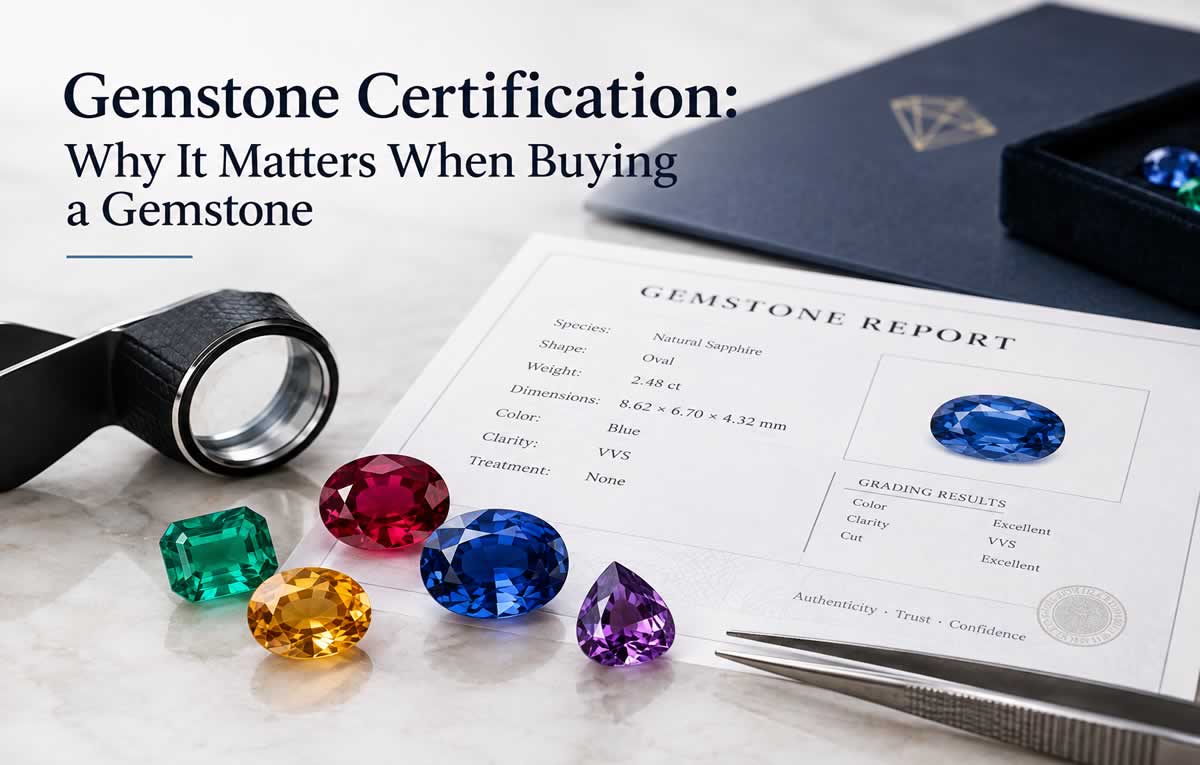
6. Consider Certification
For valuable gemstones, an independent laboratory report can provide useful information about identity, natural or synthetic status, and treatments where applicable.
7. Consider Origin
For certain gemstones, geographic origin can have a significant impact on desirability and market value.
For example, gemstones associated with famous sources may command premiums when their origin is reliably established.
Why Natural Gemstones Are Unique
One of the attractions of natural gemstones is that each stone can have its own combination of characteristics.
A natural gemstone formed deep within the Earth over geological periods may contain unique inclusions, color patterns, growth structures, and optical characteristics.
This means that even two gemstones from the same mine can look different.
For collectors and jewelry enthusiasts, these natural characteristics are often part of the gemstone’s appeal.
Gemstone Certification and the 4Cs
When purchasing a valuable gemstone, certification can provide additional confidence.
A reputable gemstone laboratory may identify characteristics such as:
- Gemstone variety
- Natural or synthetic status
- Detectable treatments
- Weight
- Measurements
- Color characteristics
- Sometimes geographic origin
However, a laboratory report does not replace your own evaluation of beauty and quality.
The best approach is to consider the certificate alongside the gemstone’s color, clarity, cut and carat weight.
Common Mistakes When Buying Gemstones
Buying Based Only on Carat Weight
A large gemstone is not automatically a high-quality gemstone.
Assuming Perfect Clarity Is Always Best
Some gemstone varieties naturally contain inclusions, and completely clean examples may be exceptionally rare.
Ignoring Cut Quality
A beautiful color can be diminished by poor cutting.
Choosing Color From a Photograph Alone
Photography, lighting, displays, and screens can influence how a gemstone appears. Whenever possible, evaluate the actual stone under appropriate lighting.
Ignoring Treatments
Always ask whether a gemstone has been treated and what type of treatment was performed.
Focusing Only on Price
An unusually low price can sometimes indicate differences in treatment, quality, origin, or gemstone type. Compare the complete specifications rather than price alone.
Frequently Asked Questions About Gemstone Colors, Clarity, Cut & Carat
What are the most important factors when buying a gemstone?
Color is often one of the most important factors for colored gemstones, followed by clarity and cut. Carat weight is also important, but its significance depends on the gemstone variety and overall quality.
Is a higher carat gemstone always better?
No. Carat measures weight, not quality. A smaller gemstone with excellent color, clarity, and cut may be more desirable than a larger gemstone with weaker characteristics.
Does gemstone clarity affect value?
Yes, but the effect varies by gemstone. Some gemstones are valued for high clarity, while others naturally contain inclusions that are accepted as part of their character.
What gemstone color is the most valuable?
There is no single most valuable color for all gemstones. The ideal color depends on the gemstone variety. Vivid, attractive, well-saturated colors are generally highly desirable.
What is the best gemstone cut?
There is no universal best cut. The ideal cut depends on the gemstone’s material, optical properties, color, clarity, and intended use.
What is the difference between gemstone carat and size?
Carat measures weight, while millimeters measure physical dimensions. Because gemstones have different densities and shapes, two stones with the same carat weight can have different dimensions.
Are inclusions a sign that a gemstone is natural?
Inclusions can provide evidence about a gemstone’s formation and may help laboratories identify natural stones, but inclusions alone do not prove that a gemstone is natural. Professional testing is more reliable.
Final Thoughts
Understanding gemstone colors, clarity, cut and carat is an important step toward becoming a more confident gemstone buyer.
Color can determine a gemstone’s visual appeal, clarity helps reveal its internal characteristics, cut controls how the stone interacts with light, and carat tells you how much the gemstone weighs. However, no single characteristic should be considered independently.
When purchasing a natural gemstone, look at the complete picture: color, clarity, cut, carat weight, treatment, origin, durability, certification, and overall beauty.
Whether you are buying a loose gemstone for a custom jewelry design, building a collection, or searching for a special stone, understanding these characteristics can help you choose a gemstone that offers the right combination of beauty, quality, and value.
A knowledgeable gemstone seller should provide clear information about the stone’s specifications and disclose relevant treatments whenever known. With the right knowledge, you can confidently compare gemstones and find a natural stone that suits your style, purpose, and budget.