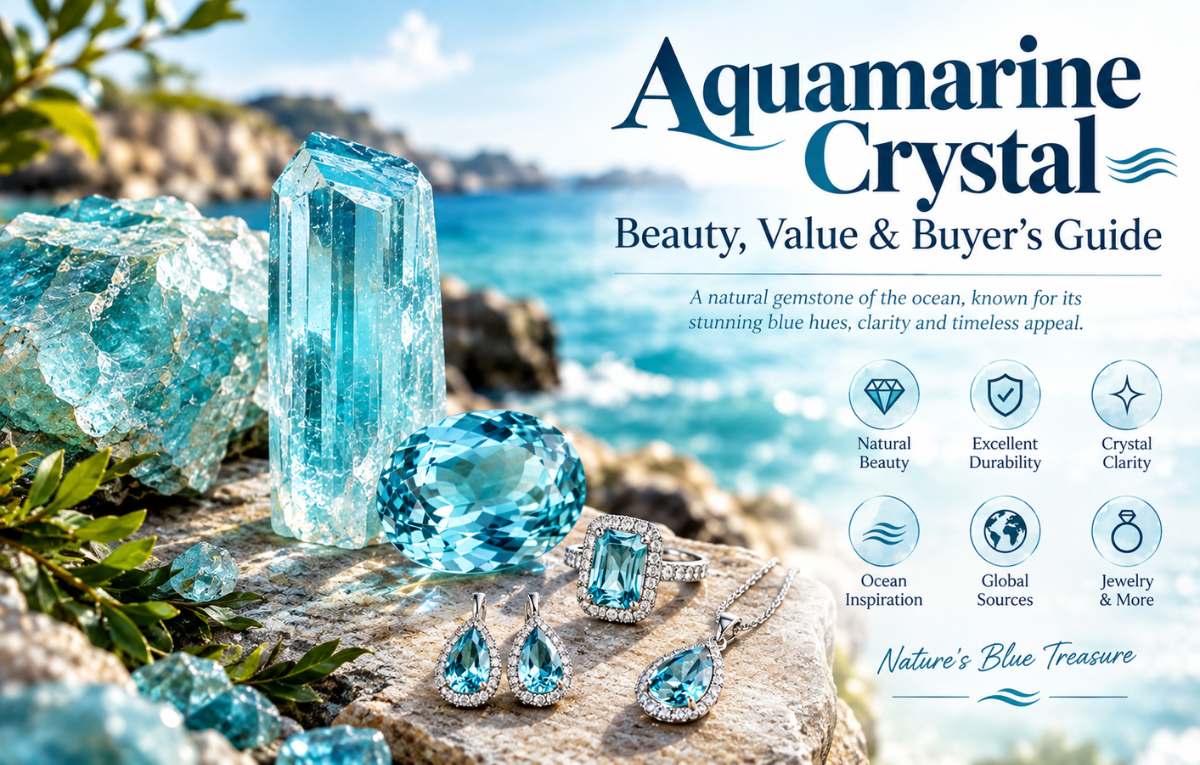
It is an ocean-themed natural blue-to-blue-green gemstone valued for its sparkling transparency, clean look, and waves modeled by the ocean. It is a member of the mineral group that also contains emerald. Emerald is known for green hue while for the fresh shades of blue, aquamarine is renowned.
This gemstone is very popular in both fine jewelry and mineral collections. It appeals to people looking for a unique natural gemstone due to its attractive color, excellent durability, and various sizes.
What Is Aquamarine Crystal?
The blue or blue-green variety of beryl is called an Aquamarine Crystal. It has a colour primarily related to iron in its lattice. From a geologic point of view, natural aquamarine forms under conditions that allow the minerals that form beryl to crystallize over an extended time.
The typical crystal form of rough aquamarine is elongated, with 6 angles. After extraction, gems can be cut and polished for use, and good natural stones can be kept in their crystal state.
- The Mohs hardness of aquamarine is roughly 7.5 – 8, which is good durability for a large range of numerous jewelry applications.
- Aquamarine crystals can be found in and around areas of water. Aquamarine crystals occur in or near the vicinity of water.
- Aquamarine crystals come in various shades of blue, from light to strong, and blue-green. Some stones are lighter in colour (paleasters), with the fine material tending to have a more vivid blue to it.
The colour of aquamarine is a major factor in choosing it. Many buyers like the blue’s colour as clear and beautiful because it provides the gemstone with a look of elegance. Even a very light piece can be a beautiful piece of jewelry, especially in the realm of minimalist designs.
Another characteristic is transparency. Aquamarine can look very clear and pass light through the gemstone, giving it an active look.
What Is The Process Of Forming Aquamarine Crystal?
Aquamarine crystals occur in nature where there are areas with high mineral content, especially from some pegmatite formations. Over long periods of time, the elements essential to the formation of beryl crystals join together under appropriate temperature and pressure, creating the crystals.
The characteristic elongated crystal forms of rough aquamarine are the result of this natural formation process.
The origin also accounts for the great diversity in color, crystal quality, and clarity of the aquamarine found.
What Are The Sources Of Aquamarine?
Aquamarine occurs in diverse locations around the world, especially in Brazil, Pakistan, Madagascar, Nigeria, Zambia, Mozambique, and Afghanistan.
Brazil is well known for its aquamarine gemstones and big crystal pieces. Another place of significance for collectors of natural aquamarine is Pakistan. Crystals have been found in their desirable shapes, colors, transparency, and other natural forms in the hilly regions of Pakistan.
Buyers in Pakistan might occasionally come across locally sourced aquamarine, but in this case, it’s important to test the quality of the individual gemstone and not take face value of its origins.
Aquamarine Crystal In Jewelry
An elegant color, the Aquamarine Crystal will lend itself to many different types of jewelry designs. It is regularly shaped into:
- Rings
- Earrings
- Pendants
- Necklaces
- Bracelets
- Custom gemstone jewelry
White gold, platinum, and silver work well with aquamarine due to its cool blue look. For a more traditional feel, you can use yellow gold to create a warm contrast and make your dress a ready-to-wear piece.
Practicality may be a factor when looking for everyday wear: rings make more impact than earrings and pendants.
There Is A Reason Why Aquamarine Crystal Is Valuable.
There are multiple factors on which the value of an Aquamarine Crystal depends, not just one.
Generally, a blue dye that has a strong color, or is attractive, is preferred over extremely light blue material.
- See-through stones are usually favored as they will give a more luminous effect.
- A cut that is well-proportioned can enhance the sparkle and serve to show off the natural color of the gemstone.
- Larger stones, of good color and transparency, may be more interesting.
- Of greater importance to collectors than faceting, the natural shape, surface quality, transparency, and formation of rough crystal can be.
- When completed by the Buyer, Treatment: Buyers should ensure he asks if the gemstone is treated or enhanced, particularly for high-value goods.
How To Choose An Aquamarine Crystal
First, look at the Aquamarine Crystal’s hue and clarity while shopping for the beautiful crystal. Evaluate from natural lighting or neutral light and see if it looks good when lit from various angles with the light source.
Then, check the stone-eye area for any type of obvious defects such as marks, chips, distracting stone-eye, or cracks. Also, take into account the symmetry and polish of faceted gemstones.
When purchasing a natural crystal specimen, review the shape, termination, surface condition, and transparency of the crystal. A good gemstone dealer will also give you information regarding the source of the gem and whether or not it was treated.
Aquamarine Crystal Maintenance Tips
Aquamarine is a relatively hard rock, but still requires careful maintenance. Use lukewarm water, mild soap, and a soft cloth to clean your gemstone. Don’t use materials that may scratch the shiny finish.
Avoid putting the stone on rough surfaces or under strong blows, and keep it away from harder gems. Individual soft compartments are a great way to reduce scratching of jewelry items.
It’s also important to think about professional inspection and cleaning of valuable pieces, which can help preserve the setting and gemstone in the long term.
Frequently Asked Questions
Did You Know That Aquamarine Crystal Is A Real Crystal?
Yes. Aquamarine is a gemstone and blue to blue green variety of Beryl naturally occurring. Natural aquamarine may form as rough crystals or gemstones.
The Color Of The Best Aquamarine Crystal Is Either Green Or Blue.
The ideal color can change from person to person, but most people like the color blue and find it clear and attractive. A more saturated color can enhance the intensity and worth of the gemstone.
Can We Put Aquamarine Crystal In Jewelry?
Yes. The hardness of about 7.5 to 8 on the Mohs scale makes aquamarine fairly durable for a variety of jewelry designs. Rings should be protected from severe impact even after they are removed.
Where to Buy Sticker Aquamarine Crystal In Pakistan?
The Aquamarine material can be obtained from Pakistani mines and from the gemstone market in various countries. If purchased from dealers in Pakistan, research the dealer’s credibility and understand all aspects of the gemstone—its quality, treatments, and its authenticity—before buying.
Final Verdict
The Aquamarine Crystal is one of the most unique ones with respect to its natural blue color, its repetition of features, its geological classification, and versatility. Its beauty lies in its color, clarity, crystal structure, and formation, whether chosen for a piece of jewelry or a mineral collection.
When making a decision on which gem to buy, it’s important to prioritize the gem’s quality, not just its size or origin. A robustly coloured, translucent, cut or shaped aquamarine will make a spectacular piece in a jewel box.